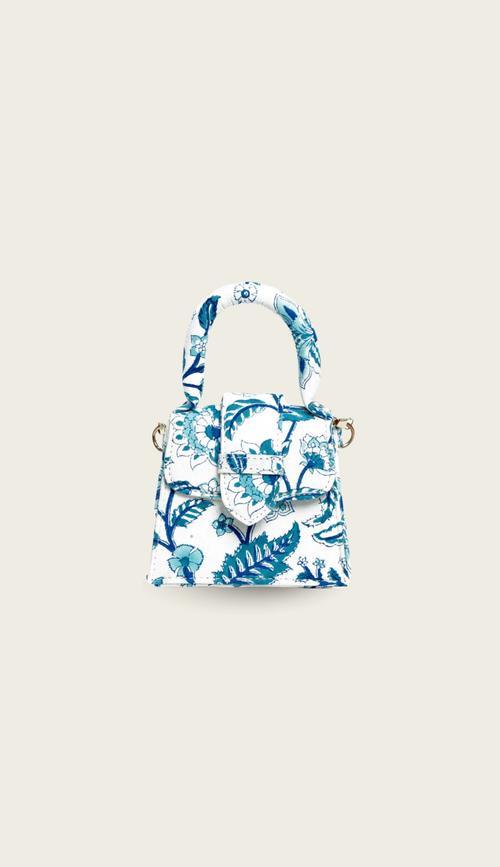
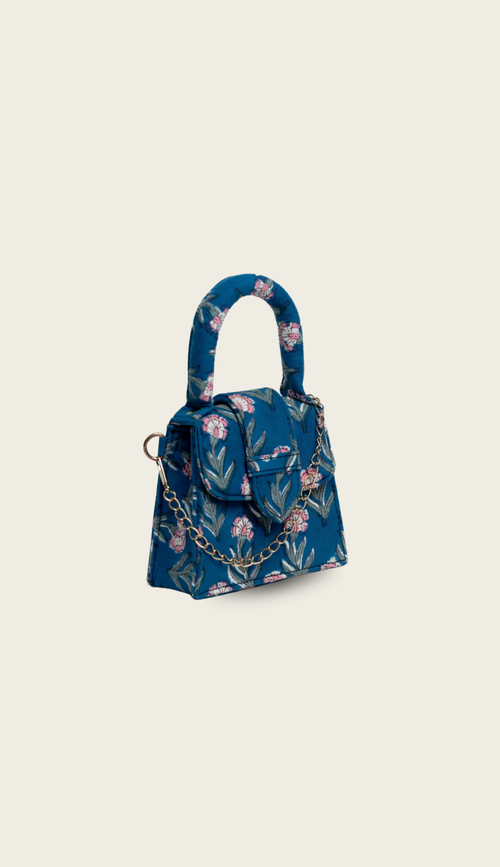
In Rajasthan, block printing has been practised for over five hundred years. Every piece in the Gullye block print collection carries that history, pressed into fabric one block at a time, by a single pair of hands.
The craft in numbers
500+ years of tradition: block printing in Rajasthan dates to the 12th century, and the same techniques are used today. Hundreds of presses per piece: a single bag's worth of fabric requires hundreds of individual block impressions, each placed by hand. One artisan, start to finish: each length of Gullye block print fabric is made by a single printer from the first press to the last.
Five hundred years pressed into every repeat
Block printing arrived in Rajasthan through the trade routes of the medieval world. Merchants carried carved wooden blocks from Central Asia, Persia, and the Mughal courts. The technique merged with local dyeing traditions, particularly the indigo and madder dyes grown in the dry Rajasthani earth, and became something that belonged entirely to this region.
By the 16th century, the block printers of Rajasthan were producing fabric for the Mughal court. The patterns were complex, the dyes were precise, and the craft required years of training before an apprentice was trusted to press a block unsupervised. The families who mastered it passed it from parent to child across generations. Many of those families are still printing today.
The motifs are not decorative afterthoughts. A geometric lattice references the architecture of the forts and palaces that surround these printing towns. A floral vine is a garden, a season, a specific moment in the agricultural calendar. When you carry a Gullye block print bag, the design on it has ancestors.

The block: teak carved by hand
Every print begins with a block. A block carver, a separate master from the printer, takes a seasoned plank of teak and carves the design into its face using chisels, needles, and files. The carving is done in reverse: what will print as a raised line is cut as a valley.
A single block for a complex floral pattern can take days to carve. The lines must be clean enough to hold dye without bleeding, deep enough to release it fully, and precisely spaced so that when the block is pressed and lifted and pressed again, the repeat aligns exactly. A badly carved block cannot be corrected. It is discarded and started again.
The dye: colour that lives in the thread
Before any block touches fabric, the cloth is prepared. Cotton is washed, boiled, and treated with a mordant, a mineral compound that bonds the dye to the fibre. Without mordanting, colour sits on top of the fabric and washes out. With mordanting, it enters the thread itself and becomes part of the cloth permanently.
Different mordants produce different colours from the same dye. Iron turns madder root from warm red to deep purple. Alum produces clear, bright red. Indigo is built layer by layer, each dip darkening the cloth. The colours in a Gullye block print have depth because the dye is in the thread, not on it.
The print: hundreds of deliberate marks
- Fabric preparation. The cotton is washed, beaten flat, and stretched on a long padded printing table. Any unevenness will show in the print.
- Dye loading. The block is pressed face-down into a tray of dye paste. Too much and it bleeds; too little and the print is weak. The printer checks by eye before every press.
- The press. The loaded block is placed on the fabric and struck firmly with the palm, then lifted cleanly. This gesture is repeated hundreds of times.
- The repeat. After each press, the printer moves the block to the next position by eye and memory. A misaligned repeat cannot be corrected. It stays in the cloth forever.
- Drying and fixing. The printed fabric dries on long lines in direct sun, which begins fixing the colour before the fabric is cut and finished.
The block is not a tool. It is the first mark of the artisan's intention. Everything that follows is the conversation between that intention and the fabric.
Each Gullye bag is cut from hand block printed fabric from Rajasthan, pressed one impression at a time by a single artisan. The small irregularities are the signature of the hand. No two pieces are the same.
Carry the block print
Cotton printed with hand carved wooden blocks, one colour at a time. The small irregularities are the signature of the hand.
Shop all block print →