Indian Artisan Craft Traditions Behind Gullye's Handmade Bags

Gullye's handmade brass bags draw on four distinct ancient Indian craft traditions — each with roots going back centuries or millennia — practiced by specialized artisan communities and passed down across generations. This is a guide to those traditions: what they are, how old they are, how they work, and where they appear in the Gullye collection.
1. Dhokra Lost-Wax Casting — The Foundation of Every Brass Bag
What Is Dhokra?
Dhokra (also spelled Dokra) is a South Asian metalworking tradition using the lost-wax casting method — one of the oldest known metal-forming techniques in the world. Archaeological evidence places its origins in the Indian subcontinent as early as 2300–1750 BCE, associated with the Indus Valley Civilization. Today it is practiced across West Bengal, Chhattisgarh, Odisha, and Telangana, in small workshops where knowledge passes from artisan to apprentice through direct practice.
How Lost-Wax Casting Works
The artisan sculpts the intended form entirely in wax — a fish, a heart, a botanical relief — capturing every surface detail. The wax is encased in ceramic. When heated, the wax melts and drains away — "lost" — leaving a hollow cavity. Molten brass is poured in and left to cool. Once solidified, the outer shell is broken away, and artisans spend additional days hand-finishing the surface. The full process takes 25 days per piece across 7 stages.
Which Gullye Bags Use This Technique
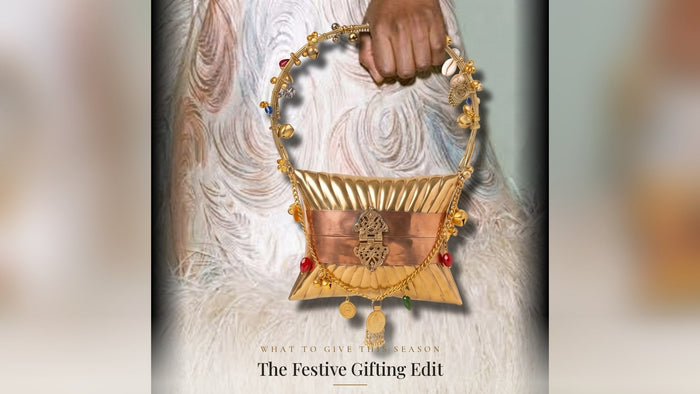
The lost-wax method is the primary technique behind most of the collection: the Matsya Minaudière (fish form, 25 days), the Amour Heart Minaudière (heart silhouette, 25 days), the Botanist Heirloom Top-Handle (botanical relief, 25 days), and the Nomad Coin Top-Handle (dual-tone, coin fringe, 25 days).
2. Kundan Stone Setting — The Gem-Setting Tradition of the Mughal Courts
What Is Kundan?
Kundan is one of India's oldest gem-setting traditions, with roots in the Mughal period (16th–19th century), originating in the royal courts of Rajasthan. The word "kundan" refers to highly refined gold (99.9% purity). Each stone is placed into a prepared channel, and kundan (refined gold foil) is pressed around it to hold it flush — no adhesive, no claws. The result is a seamless, flat-set surface.
How Gullye Uses It
The Kundan Mosaic Minaudière is first cast using the lost-wax method, then passed to a Kundan artisan who sets each colored glass stone individually — pressing gold foil behind each stone before seating it. This extends production to 30 days — the longest in the collection — and produces a full-surface stone mosaic covering the entire exterior.
3. Repoussé (Hand-Embossing) — Relief Without Piercing
Repoussé is a technique in which a pattern is pressed into a metal sheet from behind using blunt tools, creating raised surface relief without cutting the material. In India, hand-embossing has a long tradition in Moradabad, Uttar Pradesh, where decorative metalwork has been produced since at least the 12th century.
The Dholak Heirloom Minaudière (22 days) and the Argent Baroque Minaudière (25 days) both use hand-embossing. The Argent's antique silver finish is applied through controlled oxidation — darkening recessed areas, leaving raised details bright.
4. Jali (Hand-Piercing) — The Architecture of Light
Jali refers to a pierced or latticed screen, famously found in Mughal architecture at the Taj Mahal and Agra Fort. In metalwork, jali means apertures hand-cut through a metal surface, allowing light to pass through. The Lattice Jali Box Bag uses this technique — the brass body is cast, then artisans hand-pierce the geometric lattice across the full surface, each aperture individually cut and filed. Production: 28 days.
About Gullye
Gullye is a slow luxury house sourcing handcrafted accessories directly from artisan workshops in India, where techniques like lost-wax casting, Kundan setting, repoussé, and jali piercing are still practiced with the integrity of their traditional origins. Every brass bag is made over 22–30 days in batches of 3–5 per month, starting at $245.
To understand the full step-by-step making process, read How Hand-Cast Brass Bags Are Made. For a complete buyer's guide, see our Complete Guide to Handmade Brass Bags.
Frequently Asked Questions
What is Dhokra craft?
Dhokra (also spelled Dokra) is a South Asian metalworking tradition using the lost-wax casting method to create objects from brass and bronze. It is one of the oldest known metal-casting techniques, with origins traced to at least the 3rd millennium BCE. Artisans build a wax model, encase it in ceramic, melt the wax out, and pour molten brass into the cavity. Gullye's hand-cast brass bags are made using this technique.
What is Kundan stone setting?
Kundan is a traditional Indian gem-setting technique in which stones are set into a metal base using refined gold foil. Each stone is individually placed into a prepared channel, and gold foil is pressed around it — no adhesive, no claws. The result is a flush, seamless setting. Kundan dates to the Mughal era (16th–19th century) and originated in Rajasthan and Jaipur. Gullye uses this technique on the Kundan Mosaic Minaudière.
What is repoussé and how is it used in Gullye bags?
Repoussé (hand-embossing) is a technique in which a pattern is pressed into a metal sheet from behind using blunt tools, creating raised surface relief without piercing the material. The Dholak Heirloom Minaudière and the Argent Baroque Minaudière use this technique — the surface patterns are pressed into the brass by hand rather than cast, giving detailed surface texture.
How old is the lost-wax casting tradition in India?
Lost-wax casting in India dates to at least 2300–1750 BCE, with early surviving examples from the Indus Valley Civilization including the famous 'Dancing Girl' figure from Mohenjo-daro. The technique has remained in continuous practice, particularly through the Dhokra craft tradition practiced today in West Bengal, Chhattisgarh, Odisha, and Telangana.
How many days does it take to make a Gullye brass bag?
Gullye's brass bags take between 22 and 30 days per piece, across 7 stages of craft. The Dholak Heirloom takes 22 days (hand-embossed). Most pieces take 25 days (lost-wax cast). The Lattice Jali Box Bag takes 28 days (cast plus hand-pierced lattice). The Kundan Mosaic Minaudière takes 30 days (cast plus Kundan stone setting). All are made in batches of 3–5 per month.
Artisan pieces, made by hand
Every Gullye bag is made by hand in small editions, using techniques with centuries of precedent.
Shop the collection →