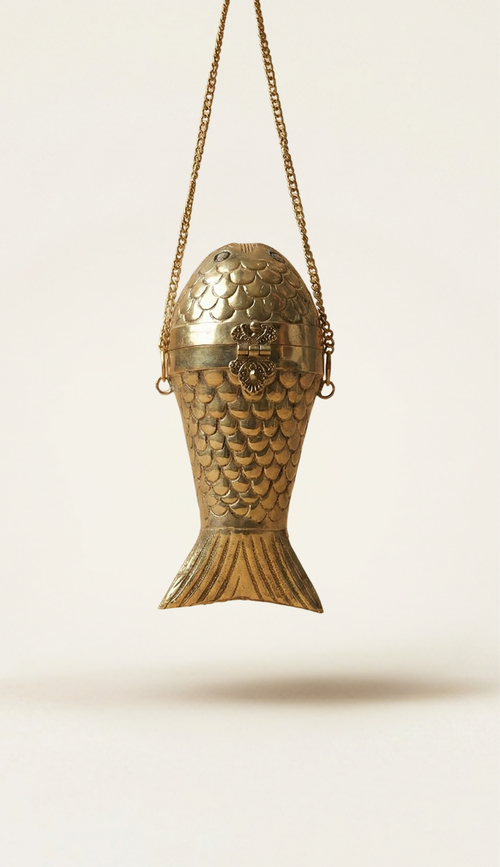
The difference between "metallic" and metal-made is process. Hand-cast pieces are shaped by heat, time, and finishing so they don't feel manufactured. They feel authored.
What hand-cast means
A hand-cast brass bag begins as a model, often in wax, becomes a mould, and is then formed by pouring molten metal into that mould. After the cast cools, the piece is refined through careful hand finishing: filing, smoothing, and polishing until the surface reads like intentional design, not raw metal.
What Is a Hand-Cast Brass Bag?
Casting creates what stamping and factory forming cannot imitate: depth, edges, relief, negative space, and sculptural volume. Lost-wax casting is a long-running metal casting method that uses a wax model to create a mould, then melts the wax out before pouring molten metal.

A Technique Older Than Fashion
Lost-wax casting shows up across many civilizations, and it is ancient: the method dates back to at least the 3rd millennium BCE. One of the most famous examples is the Indus Valley "Dancing Girl", a bronze figure made using lost-wax casting, dated roughly to 2300 to 1750 BCE and often cited as an early landmark of the technique.
It is also a living tradition. Artisan communities across multiple regions still create cast objects through wax modeling and metal pouring today, in workshops where the skill passes from parent to child.
The Hand-Casting Process, From Model to Minaudière
- The model. A form is created, often in wax, because wax captures fine detail and can be shaped with precision.
- The mould. The model is encased in a heat-resistant shell. Heating removes the wax, leaving a cavity shaped exactly like the original.
- The pour. Molten metal fills the cavity and is allowed to cool and solidify.
- Release and refinement. The mould is broken away and the cast is cleaned. Extra channels are cut off, surfaces refined, edges corrected, details sharpened by hand.
- Hand finishing. This is where the value lives: smoothing, polishing, and fitting the hinges and closure until the piece opens with a clean, precise click.
Why Hand-Cast Brass Costs More, and Feels Different
A hand-cast brass bag is not priced like a regular accessory because it is not made like one. You are paying for:
- A multi-stage process (model, mould, pour, cool, refine, finish) rather than cut-and-stitch.
- Mould economics: many casting approaches are single-use or rebuilt per piece, so there is no repeatable factory margin.
- Finishing time: the polished, wearable surface is earned through repeated hand refinement.
- Material and weight: brass is substantial, and hinges and closures must align precisely. Small errors do not stretch out the way leather does.
- Small-batch reality: these pieces cannot be produced in the thousands.
Care and Patina: Brass Is Meant to Live
Solid brass develops a natural patina over time that many owners prefer: the tone deepens and each piece becomes more individual. For a higher shine, wipe gently with a soft jewellery cloth. Keep it away from water and perfume, avoid chemical brass polish, and store it in its dust bag. A hand-cast brass bag is not a seasonal purchase. It is the kind of piece you pass down.
Carry the brass collection
Made to be noticed, and made to be kept. Solid brass and natural shell, shaped by hand, and marked a little more by every night...
Shop all brass collection →