Pendant Necklaces for Evening: How to Match One to Your Neckline

A pendant should land either clearly above your neckline or clearly below it, never on the edge itself, and for most evening necklines that means the pendant sits in open skin rather than against fabric. The second rule matters just as much and gets less attention: under artificial light, color carries further than clear sparkle.
Both rules are about the same thing, which is what the piece has to compete with. Fabric, in the first case. The room's own light, in the second.
The rule, and the one exception
The edge of a neckline is a strong line. Anything sitting exactly on it reads as an accident, because the eye cannot tell whether the pendant is on the fabric or in front of it, and it will keep trying all evening.
So the working rule is: above the line, or well below it, never at it.
The exception is a high neck. There is no skin to sit in, so the pendant will be on fabric no matter what, and the question becomes outline rather than position. Against cloth a pendant loses the contrast that makes small detail read, so a high neck wants either a distinct silhouette you can recognize at a glance, or a long chain that drops the pendant clear of the collar entirely.
By neckline
V-neck. Follow the line but stop short of the point. A pendant that sits in the middle of the V, well above where it closes, echoes the shape. One that sits at the point competes with it.
Scoop or round. Sit it in the open curve, roughly halfway between collarbone and the fabric edge. This is the most forgiving neckline for a short pendant.
Strapless or straight across. The easiest of all. The neckline is a horizontal line low on the chest, so almost any short pendant sits in clear space above it. This is where a small, detailed piece gets the most attention it will ever get.
Halter or one shoulder. The neckline is already doing something asymmetric and interesting. Either skip the necklace or keep it very short and simple, high on the throat, so the two are not arguing.
Collared or button-down. Short, inside the collar, above the first fastened button.
One practical note. Measure the chain rather than trusting a photograph, and measure it as a drop, meaning half the total length, because that is where the pendant actually hangs. A sixteen inch chain gives roughly an eight inch drop and sits at the base of the throat. Eighteen inches lands near the collarbone. Twenty and over falls onto the sternum and is the length that clears a high neck.
Why color beats sparkle after dark


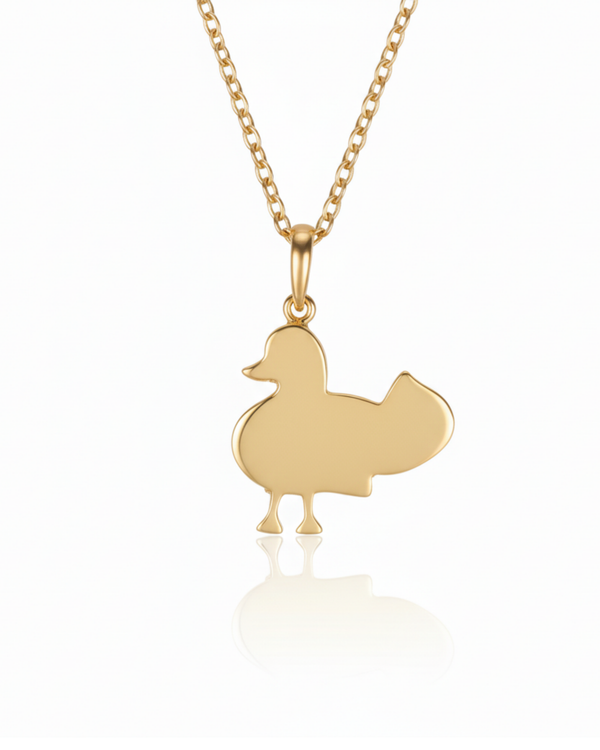
Clear stones work by returning the light that hits them. In daylight that light comes from everywhere and the effect is brilliant. In a room lit by a few warm fixtures, a clear stone returns roughly the same warm white the room is already full of, so past a few feet it stops registering as jewelry and starts reading as a small bright spot.
A colored stone returns a hue the room does not otherwise contain. That is why it holds at conversational distance and why it photographs as a defined shape rather than a flare.
The Royal Indigo Koi is the clearest case. It is not set with stones at all. The deep blue is enamel, glass fused to metal: colored powder painted into the silver channels of the fish with a needle-thin brush and fired until it turns translucent and glossy. Blue is the hardest color to fire, since too much heat burns it black and too little leaves it cloudy. The result reads as a solid block of color rather than a sparkle, which is precisely why it holds up across a table.
The Mosaic Mandarin takes the opposite approach to the same problem. Instead of one color it uses many, cobalt, ruby, emerald, amber and mother-of-pearl, each a separately hand-cut stone fitted into its own cell in the silver frame and embedded flush rather than glued. At eight tenths of an inch it is small enough to require a second look and busy enough to reward one.
The dark-stone case


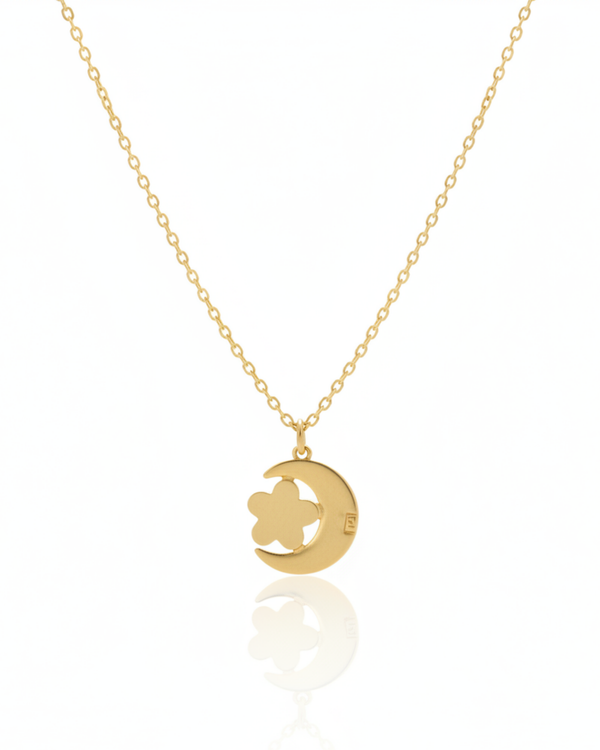
There is a third option that neither pure color nor pure sparkle covers: a dark stone next to a bright one, so the piece carries its own contrast and does not depend on the room to supply any.
The Midnight Bloom is built that way. A crescent of deep emerald-green glass, hand-cut into marquise shapes that taper as they run toward the tips of the curve, cradles a flower of clear crystal set flush into the silver. The green holds the outline and the clear center catches whatever light is going. Against a scoop or a strapless neckline, where it sits in open skin, that internal contrast is what makes an eight tenths of an inch object read at all.
These are made in very small numbers, often a single piece at a time, so a pendant you like now may not be there next month. That is a consequence of how they are made rather than a reason to hurry.
What to do if you are buying one
Decide the neckline first, then the chain length, then the pendant. Doing it in the other order is how people end up with a piece they love and never wear.
Related reading: Wedding Guest Jewelry: What Survives the Day · "Black-Tie Optional," Decoded
Frequently Asked Questions About Wearing Pendant Necklaces in the Evening
What length pendant necklace works with a V-neck?
One that sits inside the V and stops short of the point, so it echoes the neckline instead of colliding with it. In practice that is usually a chain of sixteen to eighteen inches, giving an eight to nine inch drop. The rule that matters more than the number: never let the pendant land exactly on the edge of the neckline.
Should I wear a pendant with a high neckline?
You can, but the pendant will be resting on fabric rather than skin, which removes the contrast that makes fine detail read. Choose a piece with a strong, recognizable outline, or go to twenty inches or longer so the pendant drops clear of the collar altogether.
Do clear or colored stones look better in evening light?
Colored, at any distance beyond a few feet. A clear stone returns the same warm white that most indoor lighting is already producing, so it blends into the room. A colored stone returns a hue nothing else in the room is giving off, which is what keeps its shape readable across a table and in photographs.
Carry the pendants
Made by hand in small editions. Once an edition sells out, it is retired.
Shop all pendants →